by Mike Brunel | Sep 28, 2021 | Sales, Strategy
How to hire a Superstar Salesperson each and every time
Today, I released my free report on How to Hire a Superstar Salesperson each and every time.
To coincide with releasing this free report, I wanted to share some of my thoughts around how I have hired salespeople and some key takeaways I have learned, through good and bad hires.
Who is this for?
It’s for any business owner, Sales Manager, or a startup who needs to hire a salesperson who is rewarded by a salary and performance-based performance-based
If you’ve ever hired any salespeople, like I have, you’ve usually made or have made one of these mistakes.
Just so you know, I’m fully qualified to be writing about this stuff – I’ve hired, fired, coached, or managed hundreds of salespeople, over too many years to remember, in many different countries and languages.
It’s fair to say that I’ve been through the school of hard knocks.
I hired magnificent salespeople beginning with one wonderful amazing woman, a single mum, who through sheer hard work and effort exceeded her targets in her job as a sales manager in a small media company in New Zealand.
With my main business, I was lucky to find two brothers for my U.S. operation who brought in millions of dollars.
These two superstars have certain traits, talents, and habits, that we knew would leverage our sales systems worldwide, if we could duplicate their process…. which we did.
As a result, I noticed traits in these people, secrets that I always look for. I think I know by now, what they are.
Before I go into that, let’s talk about two of the mistakes that we often make, when we go to hire salespeople.
What not to do
What’s the cost of Hiring Badly?
Think about these stats for a moment. According to a Harvard Business review article, the cost of replacing a salesperson that was hired badly ranges from $75,000 to $90,000, while other sales positions can cost a company as much as $300,000.
These figures don’t reflect the lost sales while a replacement is found and trained.
One of my good friends who owns a telecommunication company has told me a bad hire for him costs a least $1 million over time.
That’s horrendous. This may not change as we enter this new world of communication. As a company or small business, you simply cannot afford to hire on gut alone.
Is Fit Important? Maybe.
A culture fit in any business is important, there’s no doubt about that, but what you need to discover firstly is “Does this person have the ability/talent to do the job?”
That is the underlying question that needs to be asked by you as an employer of salespeople.
In the next blog, I am going to cover off some of the common mistakes that we made when we hired a salesperson for our business.
Download my FREE report to learn more, or email me… mike@mikebrunel.com

Mike Brunel started mikebrunel.com after being a successful entrepreneur and founder of NRS Media. He co-founded NRS Media in Wellington, New Zealand, expanded it into a global powerhouse in media sales and training, and was eventually responsible for opening offices in London, Atlanta, Toronto, Sydney, Capetown, and Bogota. His products and services are now sold in 23 countries and in 11 languages generating $350 million annually in sales for his clients. Mike sold the company in 2015 and now spends his time following his passions which include rugby, travel. His promise: “I can find thousands of dollars in your business within minutes – GUARANTEED” TRY ME!
by Mike Brunel | Sep 7, 2021 | Sales
The Fast and the Furious: Sales Edition
Have you heard of Speed Selling?
It’s a great way to launch a company, and I have participated in it several times.
Over the years, it has become more sophisticated, and my old company, NRS Media, (since sold) has fine-tuned it to launch a brand new media company into profit from day one. I’ll delve more into that idea later.
How a small town radio station became the birthplace of Speed Selling.
My first experience with Speed Selling was at a part-time radio station in a small town with a population of 15,000 people.
As FM radio developed in my country, many potential operators were given temporary licenses to run 90-day radio stations, usually in tourist towns.
The potential bidder who was proposing a full-time license used this temporary 90-day station concept to build credibility and see if a format they used would be accepted by the community. If they did, they were granted a full-time FM license.
Each salesperson was given a specific “show to sell,” such as the “Top Ten at Ten,” the “American Top 40 with Rick Dees,” sponsorships, and any generic music program that could be sold off for 90 days.
The trick was that there was no set price on the program, just a guideline.
The sales rep could not go below the number, but they could go above it. The highest price got the sale, and the sales manager was the final judge.
The competition was held for an hour for each show, and each rep had to go out and cold call, sell the product, and get the client to sign an agreement with the time and price they were prepared to pay. If the price was acceptable to the sales manager, the rep got the next sale, and off they went with a 15-minute bonus.
The other reps had to sit around for 15 minutes before they could go out and sell the next program. It proved very successful and loads of fun.
How Bootcamps Helped NRS Media salespeople become confident and Effective.
One to Many is another tool for Speed Sell.
This idea built my previous company NRS Media from zero sales to $350 million annually.
It was a seminar-based model where business owners were invited to a hotel to hear the latest trends and ideas on advertising.
Usually, there were groups of 15-20 advertisers. At the end of the presentation, every attendee was offered an advertising package, usually a 12-month investment. On average, we could generate $600-$1 million in sales using this model over a week!
Taking action and speed in selling is very important.
How Bootcamps Helped NRS Media Salespeople Become Confident and Effective.
Often the one ingredient missing is training, which cannot be ignored.
I wrote all the sales and marketing manuals (playbooks) at NRS Media and perfected the execution, but without our famous Bootcamps, our people would never have had the success they achieved.
(I am going to expand on the power of Bootcamps in a future blog. )
Training is the one neglected tool that gets you the most sales.
Many companies ignore it because it takes time, but as the saying goes, “We could not afford not to do it.”
In conclusion, Speed Selling is an effective way to sell products and launch a company. It can be adapted to any business if you have a product launch that requires speed. There are a few more Speed Selling ideas that I would love to share, so find a way to sell more of your stuff.
As always.
Find a way to sell more of your stuff….
Mike (speed sell ) Brunel
PLUS, whenever you are ready…here are four ways I can help you grow YOUR business.
My favourite thing to do is show you what’s working right now. It’s not as good as being a client, but it’s close.
2. Take advantage of a FREE 45-minute consultation
Need some sales support? Make an appointment, and let me take you through the past, present, and future templates.
3. Work with me one-on-one
If you are wanting to take your product or service from face-to-face to virtual selling, then I have a product that may be able to help you. You can get started for as little as $250 a month. If you’re interested then email mike@mikebrunel.com and put ‘Virtual Selling’ in the subject line…tell me a little about your business and I’ll get you all the details.
Mike
Mike Brunel started mikebrunel.com after being a successful entrepreneur and founder of NRS Media. He co-founded NRS Media in Wellington, New Zealand, expanded it into a global powerhouse in media sales and training, and was eventually responsible for opening offices in London, Atlanta, Toronto, Sydney, Capetown, and Bogota. His products and services are now sold in 23 countries and in 11 languages generating $350 million annually in sales for his clients. Mike sold the company in 2015 and now spends his time following his passions which include rugby, travel. His promise: “I can find thousands of dollars in your business within minutes – GUARANTEED” TRY ME
by Mike Brunel | Aug 31, 2021 | Leadership, Sales
Start a Conversation with Yourself
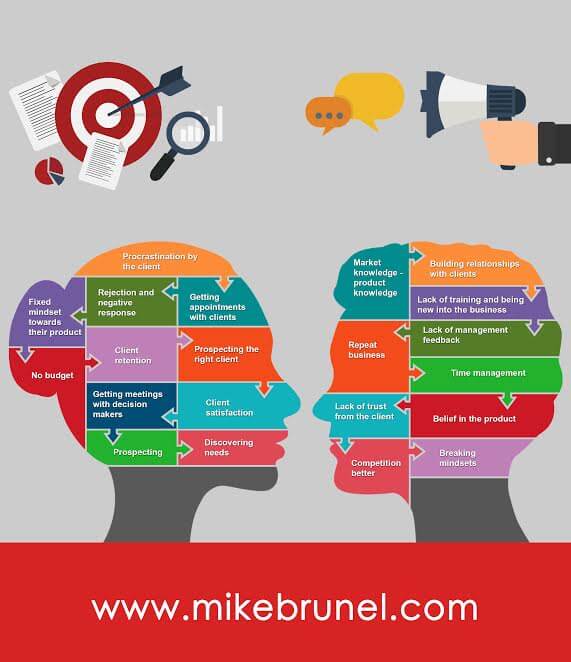
A successful sales relationship hinges on the ongoing conversation you have with your customer. The dialogue starts, strangely enough, with the conversation you have with yourself.
You can listen to others more effectively when you know how to listen to yourself. I first learned this years ago at that first media company job.
They sent me to a conference in Houston, Texas. I had just come out of a long-term relationship and to be totally honest, I felt a little bit lost.
I remember sitting in a hotel room and coming across an infomercial featuring a very youthful Tony Robbins promoting something he called “Personal Power.”
I was intrigued enough to buy what Robbins was selling. When I got back to New Zealand, there was a box waiting for me with Tony’s signature on it.
Love of Knowledge.
I devoured the material; it re-ignited my love of knowledge and showed me how to improve my outlook and my self-talk.
I did all the exercises and kept a journal. One skill I learned was how to ask quality questions of myself. It started with questions recorded in a journal and culminated in a completely new focus that brought better results. The disparity in the quality of people’s lives often comes down to the difference in the questions they consistently ask.
You prime your mental computer to look for a particular type of answer. If you’re asking, “What’s wrong with me,” your mind will come up with an answer—you are stupid or you don’t deserve to do well.
On the flip side, if you ask questions like “How can I take this experience and use it to contribute to others’ lives,” your brain will come up with much more constructive answers.
You will be able to see the path forward, rather than feeling like you have reached a dead end.
Conversation Questions to help your Self Talk
Here are some examples from my long-ago journal:
• What am I happy about in my life right now?
• What about that makes me happy and how does it
make me feel?
• What am I most excited about in my life right now?
• What makes me excited?
• What am I grateful for in my life?
• What am I committed to in my life right now?
Conversations Matter.
Asking these questions helped me see clearly how positive questions lead to a growth mindset, which leads to better results down the road. When you think in terms of constructive, positive questions, your brain goes off and works on
them even when you’re not thinking about the answers consciously.
For example, consider the difference between “Why does this always happen to me?” and “How can I learn from
this experience?” They are simply worlds apart in terms of choosing your next step.
Develop a pattern of questions that empower you. If you seek a shift in your life, make this part of your daily routine.
Over time, asking these types of questions changes how you question your clients.
Have fun selling your stuff.
Mike Brunel started Mikebrunel.com after being a successful entrepreneur and founder of NRS Media. He co-founded NRS Media in Wellington, New Zealand, expanded it into a global powerhouse in media sales and training, and was eventually responsible for opening offices in London, Atlanta, Toronto, Sydney, Capetown, and Bogota. His products and services are now sold in 23 countries and in 11 languages generating $250 million annually in sales for his clients. Mike sold the company in 2015 and now spends his time following his passions which include rugby, travel. His promise: “I can find thousands of dollars in your business within minutes – GUARANTEED” TRY ME OUT!
by Mike Brunel | Aug 17, 2021 | Sales
Reducing your business expenses is easier than you think
A leading manufacturing company based in Japan is said to have saved a quarter of a million dollars just by turning off the lights.
The company ran a competition with a reward asking people to answer this question:
How can we save money in our company without damaging, effecting or interrupting the day to day operation of the business?
It’s as simple as flicking a switch
The staff at the company embarked on a weeklong program in groups from senior management right down to the factory workers. Once the final entries were collated the prize went to one of the lowest paid workers.
Their suggestion was simple: turn all the lights out in the computer room and factory where automatic robots assembled parts for major components. The worker was awarded 20 percent of those first savings as their reward.
The solution is right in front of you
Sometimes the best solution to a problem was right in front of you the whole time. The answer doesn’t always need to be complicated and simpler is often better. Management doesn’t exclusively have the answers so put your problem to all your employee’s. You might be blown away by the responses from you lower-skilled departments.
Happy selling everyone!
Mike
About the Author:
Mike Brunel started Mikebrunel.com after being a successful entrepreneur and founder of NRS Media. He co-founded NRS Media in Wellington, New Zealand, expanded it into a global powerhouse in media sales and training, and was eventually responsible for opening offices in
London, Atlanta, Toronto, Sydney, Capetown, and Bogota.
His products and services are now sold in 23 countries and in 11 languages
generating $250 million annually in sales for his clients. Mike sold the company in 2015 and now spends his time following his passions which include rugby, travel. His promise: “I can find thousands of dollars in your business within minutes – GUARANTEED” TRY ME OUT!
by Mike Brunel | Aug 4, 2021 | Sales, Strategy
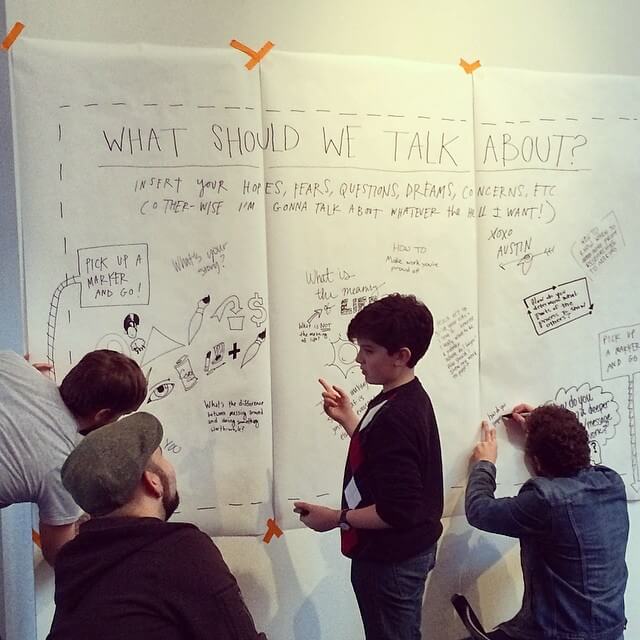
Photo – Austin Kleon- Steal like an Artist
“Are Sales are contingent upon the attitude of the salesperson? Or the attitude of the prospect”
I get to hear good stories from all over the world as to how salespeople are making a difference to people’s lives.
In many situations businesses worldwide are feeling (according to them) the pressure of not getting their numbers, the market is tough, it is not like it used to be, people are simply not buying like they used to, the excuses seem to go on and on.
I want to debunk that, it simply is not true. I know that if you offer value, and are committed to your customers, they will buy off you.
Money is still there.
The truth is that the money is always there, it may be less for some, but nonetheless, it is always there, it just moves around. It might move from your business to another, but the facts are that that retail revenue is up in countries like NZ and Australia.
It might move from your business to another, but the facts are that that retail revenue is up in countries like NZ and Australia.
The thing is that businesses have to do things differently; they need to think about how their clients are purchasing their product.
I can guarantee that in most homes these days television and other media is not the main source of entertainment or information.
The internet has become a big part of our lives.
Clients do research your product along with your competitors before they even venture into your store or place of business.
Information is Power.
Many business owners that I have worked with all over the world have had to come to terms with a changing market.
The ones I notice that are doing well train their staff on a regular basis, keep them up to date with all the new products or services, help them make the decisions, this is done usually at least once a week.
In any business product knowledge is based upon attitude, if you visit a store and a staff member does not know their product what happens?
You lose confidence, you are not really sure if they are to be trusted, you might retreat, and go off to someone else.
Want a secret to more Sales?
Product knowledge and information about a product have an invisible benefit. It gives the salesperson the “right attitude” it rubs off. They get confident, and the clients feel that confidence.
Try these simple exercises that work.
Here a just two exercises you can do in your business to get your team to buy into product knowledge training.
- POP QUIZ- write up 10 benefits of your most popular products, list what you think is the #1 benefit for the customer if they buy this product.
- TEST ONE ON ONE, OR IN A TEAM MEETING – Give each of your staff a test on every one of those products. You can do it in written form or as part of their one on one meeting.
These simple tests can give your business a foot up and you might get an extra share of the money that is out there.
Have a great day selling your stuff.
Mike
PS. If you want a simple test format to help you do that then download our 7 day Sales Mindset Challenge. Or if you need help to help your team make more sales or get more leads then contact me.
“Sales are contingent upon the attitude of the salesperson, not the attitude of the prospect” –William Clement Stone.
by Mike Brunel | Jul 27, 2021 | Sales, Uncategorized

All Systems Go- The Journey Begins.
In my last blog, I talked about Selling what you can’t see, and how Doug Gold, my business partner and previous owner of the More FM network came up with an idea to sell media inventory that went on to dominate the direct media sales world for well over 20 years.
After his first launch of the Gold Key Programme in Wellington New Zealand, we knew we were on to something special. The product and the problem had changed, as had our approach. Spots and Dot selling were out, and membership was in.
Looking back, it was revolutionary, no one was selling media this way. Subscription-based selling had been around for 50 years, now everyone thinks its the ‘new new thing”. All we did was apply that model to selling inventory on media companies.
I was initially invited into the company as a consultant, but when I saw what Doug had created, it was as if a light went on, I knew that if I could build a sales system that could duplicate the concept he was presenting in that room in a hotel in Wellington, I could leverage it.
I sat in on all the presentations as an observer for a week, watched how all the salespeople sold. I monitored how the clients bought. I recorded the presenter’s speeches and analyzed all the ways that they presented the product. Then I went away and created the first Image Plus programme. A predictable lead generation product that would pretty much guarantee a result. Then I took it to my partner who had just gone to Australia to set up our consultancy services, the wonderful Mr. Duffy.
I think we are onto something”
Brian Duffy trusted me to package it up and take it to a client of his in Hobart, Tasmania. I went in and said, “If you follow this system, I can write a million dollars in revenue for you guaranteed” We launched the program and generated $1 million in four days. In today’s money that’s around $4.5 million. Our cut was a commission fee on the revenue generated.
Boom! We were smoking! I remember at the time watching Brian writing on a small business card how many we had sold each session, after the third session, he came over to me and said. ” I think we are onto something, I count thirty gone of our allocated 100 memberships and its only day one, I’m excited”!
Success is Natural
People look at that success and assume it takes a team of natural salespeople to develop and execute such an idea; they don’t believe they can do it themselves. Granted, I have a passion for the business, but I came from a very small country where nobody was doing this sort of thing. We had some brave, courageous risk-takers as our first clients.
The early adopters in Hobart said, “Yeah, we’ll give it a go” and we were grateful. You may not think you are a salesperson, but if you are in any kind of business, you are just as much a salesperson as Doug, Brian, and me, and you can find clients willing to take the leap with you.
Practice Makes Perfect.
Of course, the journey that NRS Media took has not always been easy. I remember one time I was presenting near Lincoln, Nebraska, expecting 300 people to attend our seminar. Five turned up.
When something like that happens, all you want to do is hide. If you could, you would actually crawl in a hole, pull the cover over the top, and not come back out. Sometimes it seemed like I was on my own and the rebuffs were never-ending. I had a bit of natural resilience, but it really is a lonely place, selling in America is a tough gig. Many people avoid sales because they fear rejection.
Sell something you Believe in.
What you have to remember, though, is that if you are doing something you love, selling something you believe in, then you are performing a service. You are not ripping off the customer, or doing the wrong thing by them. Someone is going to buy it from you. As long as you remember that, you can lift your head back up and start again.
Take Flight from Fright
You should realize that most people don’t take naturally to selling. I often see people so frozen they’re afraid to pick up the phone. Folks freeze with fear, unable to make the call. They’re paralyzed with fright. Excuse my language, but they’re sh*$$!ng themselves because they’re so afraid of the reaction. Many people find selling terrifying; it’s a natural human reaction.The thing is, this fear comes through in their work and makes them less effective.
If you own a product, service, or a business, you have to sell. If you’re passionate, believe in that product, and know that your customer should have it, then don’t be afraid to go and present it.
Try not to think of it as asking a yes-or-no question. Instead, picture yourself helping the customer through the decision-making process. Simultaneously, you come to comprehend their needs, wants, and desires. If you can honestly say, “Look, this is my product. I believe in it. I think it’s right for you,” and you come from a position of integrity people will respond. All it takes is a shift in perspective. Stop thinking, “I’m not in sales.” Reframe that thought.
Call it Something Else.
Call it something else. Recognize it for the relationship building process it really is. Changing my mindset has helped me personally banish the fear of rejection. At first, I tried half-heartedly and then gave up, just like anyone else. I realized, though, that if I didn’t change the way I thought about sales, I was going to lose. Today, I help salespeople change their frame of mind so they’re working steadily toward a reward rather than flailing about trying to avoid failure.
I remember working with a new salesperson on this issue. He was seriously afraid of going out and talking to people, so we gave him some new words to practice just before the sales call.
We asked him to say “relationship building” instead of “selling” in his mind and we saw right away the fresh connections he was making. His new vocabulary changed his mindset. He was much more comfortable—and successful—in his calls after he implemented this simple tool.
Successful sales also means maintaining relationships with clients over a long time period without getting the payoff of a “yes.” In the early days of my business, I remember approaching clients who would say no three, four, or five times. I considered that a failure. I thought, “Well, I just can’t do it.”
What did I learn?
Successful sales also mean maintaining relationships with clients over a long time period without getting the payoff of a “yes.” In the early days of my business, I remember approaching clients who would say no three, four, or five times. I considered that a failure. I thought, “Well, I just can’t-do it.”
What I discovered, though, was that I had to see rejection as a temporary setback and make plans to move on. I had to say to myself, “Okay, Mike, what did you learn and what could you do differently? Could you apply a different approach to that problem? Let’s try it and see what happens then.”
If you want to build leverage into your business like we did, then let’s talk.
Selling is easy “it’s just how you think about it”
Mike
PS. Not ready for a catch-up call then dive into my ‘new’ just-released audio programme